

Fujifilm Klasse S: A Classy Little 35mm Point & Shoot




What a Classy Little Camera: The Fujifilm Klasse S
There are point & shoots.
And then there are point & shoots.
The Fujifilm Klasse S is one of the latter.
It's small, light, beautifully made and has the kind of lens that makes you understand why people are willing to pay completely unreasonable amounts of money for a compact film camera.
I actually used to carry one as a backup to my Contax G2, usually loaded with a different film. And almost every time I shot a roll with it, I came away thinking the same thing:
Why am I carrying the G2?
A little bit of everything
The Klasse S is a 35mm compact camera, but calling it a point & shoot doesn't really tell the whole story.
You've got a 38mm f/2.8 EBC Fujinon lens, autofocus, automatic exposure, aperture priority, exposure compensation, manual focus, different flash modes and the ability to adjust the film speed. It's a surprisingly serious amount of control for something that can disappear into a jacket pocket.
And that's what makes the camera interesting.
You can literally turn it on, point it at something and shoot.
Or you can start messing around with the settings and actually get involved.
It's happy doing either.
Paris, black & white
I took the Klasse S to Paris.
And obviously, Paris had to be shot in black & white.
I loaded it with Kodak Tri-X 400, pushed it one stop to 800 ISO and basically walked around shooting.
The results were great.
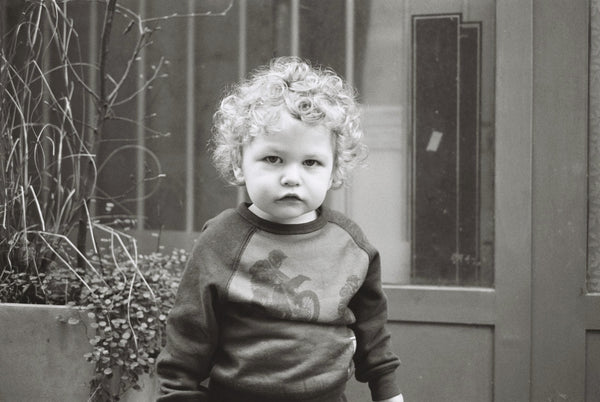
The 38mm lens is sharp without feeling clinical, and the pushed Tri-X gave the images a little more contrast and drama while keeping plenty of detail.
It's one of those combinations where the camera just seems to get out of your way.
You walk.
You see something.
You shoot.
Next.
That's probably the best thing a compact camera can do.
Small enough to actually carry
The Klasse S weighs around 265g without the battery, so it's properly pocketable. The body is rounded, the lens sits nicely in the middle and the grip feels much more natural than you might expect from such a small camera.
The controls are also surprisingly good.
There's a thumb dial on top that lets you switch between program and aperture priority, while exposure compensation is positioned on the front of the camera, close to the lens.
It all feels very deliberate.
Nothing is particularly flashy. Everything is just where you'd expect it to be.
And after using it for a while, you stop thinking about the controls altogether.
Which is exactly what you want.
More than just “auto”
This is where the Klasse S starts getting interesting.
You can use program mode and let the camera make all the decisions.
Or switch to aperture priority and decide how much depth of field you want.
You can lock autofocus, adjust the film sensitivity, compensate exposure, change flash modes, use manual focus and even shoot with longer shutter speeds or bulb mode. There's also a self-timer and exposure bracketing.
Is all of this necessary on a pocket camera?
Probably not.
Is it fun to have?
Absolutely.
The only thing I found slightly annoying was the mode system. There are quite a few options packed into that little dial, and it takes a minute to remember where everything lives.
But once you've figured it out, it's pretty intuitive.
Not quite perfect
The Klasse S isn't magic.
The autofocus is reasonably quick, but there is a noticeable little delay between pressing the shutter and the camera actually taking the photograph.
If you're trying to catch something happening right now, that can be annoying.
You can miss the moment.
And that's worth knowing if you're buying one specifically for fast street photography.
On the other hand, the camera focuses down to around 40cm, which gives it a real advantage for closer subjects. That's considerably closer than some of its high-end compact competition, and it opens up a lot more possibilities for portraits and detail shots.
So, is it actually worth the hype?
The Klasse S sits in that slightly ridiculous category of compact film cameras that people now talk about in the same breath as the Contax T3, Ricoh GR1 and Konica Hexar.
And honestly, we get it.
It's not because it's the smallest camera.
It's not because it has the most features.
It's because it gets a lot of things right at the same time.
The lens is excellent. The body is genuinely pocketable. The controls give you enough freedom to actually make decisions, but you can still ignore all of them and just shoot.
That's a pretty good combination.
For me, the best test was simple:
I had a Contax G2.
I still wanted to take the Klasse S with me.
And sometimes it was the one that got used.
All photographs by Alessandro Iotti.


